Computer Graphics & Digital Image Processing MCQS with Answer SET 5

1 Comment »

Computer Graphics & Digital Image Processing MCQS with AnswerS


We have made some Computer Graphics & Digital Image Processing MCQS (Mulitiple Choice Questions) which helps to prepare for competitive exams and various university exams or btech computer science 6th sem exams.This might be usefulgate preparation too.

Q61. Which of the following is not a video standard ?

a)      CGA
b)      EGA
c)       VGA
d)      TGA

Q62. CGA is one of the video standards and its full form is :

a) Color Graphics Adapter
b) Complex Graphics Adapter
c)None of these
d)Color Graphics Array.

Q63. VGA is one of the video standards and its full form is :

a)      Video Graphics Array
b)      Video Graphics Adapter.
c)       None of these.
d)      Versatile Graphics Adapter.

Q64. Refresh rate is defined as:\

a)      No. of times per second the resolution
b)      No. of times per second the pixels are recharged so that image does not flicker.
c)       Neither a ) nor b)
d)      Either a) or b)

Q65.A flickering issue occurs when

a)video refresh rate is too high
b)None of these.
c) video refresh rate is too low
d)Video refresh is an average.

Q66. Which of the following statements are  false ?

a)Frame buffer is the portion of video card memory that holda the information necessary to display a single screen image.
b)The size of frame buffer determines the resolution and maximum colors it is able to display.
c)  None of these.
d)A flicker issue can occur when video refresh rate is too low.

Q67. Translation is a rigid body transformation that moves objects ………………….

a)with distortion
b)without distortion  
c)either a) or b)
d)None of these

Q68. Which of the following equation in reference to SCALING , donot  have any meaning in practical terms ?

a)sx=sy >1
b)sx=sy<0
c)sx=sy=0
d)None of these.

Q69. Which of the following transformation is known as Flip transformation ?

a)Reflection   b) shearing            c)scaling      d)None of these.

Q70. Which of the following transformation is known as Shift transformation ?

a)Reflection    b) shearing            c)Translation      d)None of these.

Q71.  Which of the following transformation is known as ZOOM  transformation ?

a)Reflection   b) shearing            c)scaling      d)None of these.

Q72. Which of the following transformation matrix represents the reflection about x-axis ?

a)                      
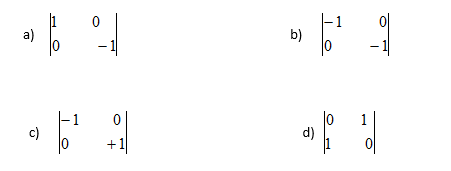
Computer Graphics & Digital Image Processing MCQS with Answer

         Q73. Which of the following transformation matrix represents the reflection about y-axis?

Computer Graphics & Digital Image Processing MCQS with Answer


Q74.Which of the following transformation matrix represents the reflection about origin?
Computer Graphics & Digital Image Processing MCQS with Answer


Q75. Which of the following transformation matrix represents the reflection about line y=x ?
Computer Graphics & Digital Image Processing MCQS with Answer
Computer Graphics & Digital Image Processing MCQS with AnswerS
                
61 d
62 a
63 a
64 b
65 c
66 c
67 b
68 b
69 a
70 c
71 c
72 a
73 c
74 b
75 d

Computer Graphics & Digital Image Processing MCQS with Answer SET 4

1 Comment »

Computer Graphics & Digital Image Processing MCQS with AnswerS

We have made some Computer Graphics & Digital Image Processing MCQS (Mulitiple Choice Questions) which helps to prepare for competitive exams and various university exams or btech computer science 6th sem exams.This might be usefulgate preparation too.

Q46. Which transformation produces a mirror image of an object ?

a)Rotation       b)shearing                  c)scaling                               d)reflection.

Q47. Which transformation is described as rotation by 180 degree ?

a)Rotation       b)shearing                  c)scaling                               d)reflection

Q48. What is the average access rate of 1024x1024 frame buffer , with an average access rate per pixel of 200ns on a simple color display?

a)1.6                                       b)1.5                             c)1.4                    d)None of these.

Q49. In a 512x512 raster on a monochrome display with an average access rate of 200ns per pixel.What is refresh rate?

a)16.07                                    b)19.07                           c)15.07                         d)None of these.

Q50. Consider Raster System with resolution of 640x480 . what is the size of frame-buffer (in Bytes) is needed to store 12-bits per pixel ?

a)460800                                      b)1920 KB                                          c)7.5MB     d)None of these.

Q51. Consider Raster System with resolution of 1280x1024 . what is the size of frame-buffer (in Bytes) is needed to store 12-bits per pixel ?

a)460800                                      b)1920 KB                                          c)7.5MB     d)None of these.

Q52. Consider Raster System with resolution of 2560x2048 . what is the size of frame-buffer (in Bytes) is needed to store 12-bits per pixel ?

a)460800                                      b)1920 KB                                          c)7.5MB     d)None of these.

Q53. Which classification of Polygon is based on where the line-segment joining any two points within the polygon is going to lie ?

a)Convex Polygon        b)Concave polygon     c)None of these        d)Both of these.

Q 54. Which classification of Polygon is not based on where the line-segment joining any two points within the polygon is going to lie ?

a)Convex Polygon        b)Concave polygon     c)None of these        d)Both of these.

Q55. As in Even-Odd Method , the point is considered inside the Polygon Boundary if
a)even no. of intersections                             
  b)odd no. of intersections                  c)either a or b                         d)neither  a  nor  b

Q56. Which of the following transformation  is called as twist or tilt transformation ?

a)      Shear trandformation
b)      Scale transformation
c)       Translation
d)      None of these

Q57.How many electron guns are used in CRT ?

a)3      b)2        c)4     c)none of these

Q58. How many electron guns are used in DVST ?

a)3      b)2        c)4     c)none of these

Q59. Which of the following statement is true ?

a)DVST has no referesh buffer thus to eliminate a picture section ,the entire screen must be erased and to modified.
b)DVST creates bright picture.
C)Both (a) and (b).
d) None of these.

Q60. Aspect ratio is defined as :

a)      No.of horizontal points
b)      No. of vertical points.
c)       (a) divided by (b).

d)      None of these

Computer Graphics & Digital Image Processing MCQS with AnswerS

46 d
47 d
48 a
49 b
50 a
51 b
52 c
53 a
54 b
55 b
56 a
57 a
58 b
59 c
60 c

Computer Graphics & Digital Image Processing MCQS with Answer SET 3

No Comments »

Computer Graphics & Digital Image Processing MCQS with AnswerS

We have made some Computer Graphics & Digital Image Processing MCQS (Mulitiple Choice Questions) which helps to prepare for competitive exams and various university exams or btech computer science 6th sem exams.This might be usefulgate preparation too.

Q31.  If a line is drawn from A(5,5) to B(13,9) using Bresenham’s Algorithm .Then  if First pixel is (5,5) then sixth pixel is :
a)(7,6)                       b)(6,6)                            c)(8,7)                                    d)None of these

Q32. Let a triangle is defined by A(2,2), B(4,2),C(4,4) and is rotated by 90 degree about an origin .Then after transformation point A(2,2) will be transformed into :

a )A’(-2,4)                                              b) A’(-2,2)                                                              c)   A’(-4,4) 
d) None of these

Q33. Let a triangle is defined by A(2,2), B(4,2),C(4,4) and is rotated by 90 degree about an origin .Then after transformation point B(4,2) will be transformed into :

a )B’(-2,4)                                              b) B’(-2,2)                                                              c)   B’(-4,4) 
d) None of these

Q34. Let a triangle is defined by A(2,2), B(4,2),C(4,4) and is rotated by 90 degree about an origin .Then after transformation point C(4,4) will be transformed into :

a )C’(-2,4)                                              b) C’(-2,2)                                                              c)   C’(-4,4) 
d) None of these

Q35. When a square ABCD , whose coordinates are A(0,0) , B(3,0),C(3,3),D(0,3) is translated by 2 units in both of x-direction and y-direction .Then after translation , point A(0,0) is transformed into :

a)A’(0,3)                                           b)A’(2,2)                                  c)A’(5,2)                             d)A’(5,5)


Q36. When a square ABCD , whose coordinates are A(0,0) , B(3,0),C(3,3),D(0,3) is translated by 2 units in both of x-direction and y-direction .Then after translation , point B(3,0) is transformed into :

a)B’(2,5)                                           b)B’(2,2)                                  c)B’(5,2)                             d)B’(5,5)

Q37. When a square ABCD , whose coordinates are A(0,0) , B(3,0),C(3,3),D(0,3) is translated by 2 units in both of x-direction and y-direction .Then after translation , point C(3,3) is transformed into :

a)C’(2,5)                                           b)C’(2,2)                                  c)C’(5,2)                             d)C’(5,5)


Q38. When a square ABCD , whose coordinates are A(0,0) , B(3,0),C(3,3),D(0,3) is translated by 2 units in both of x-direction and y-direction .Then after translation , point D(0,3) is transformed into :

a)D’(2,5)                                           b)D’(2,2)                                  c)D’(5,2)                             d)D’(5,5)

Q39.   Which transformation changes  the  size of object ?

a)shearing                                         c)rotation
b)scaling                                         d))None of these

Q40. Which transformation distorts the geometry of object ?

a)shearing                                         c)rotation
b)scaling                                         d))None of these

Q41. Is two-Dimensional rotation and scaling is commutative if Sx=sy or ɵ=nΩ  ?

a)      Yes                      b) No                               c)  None of these                   d) may be.

Q 42. If a triangle with vertices A(0,0), B(1,1),C(5,2) to twice its size, while keeping C(5,2) fixed , then A(0,0)  will be transformed into :

a)A’(-3,0)                                      b)A’(-5,-2)                            c) A’(5,2)                               d)None of these

Q 43. If a triangle with vertices A(0,0), B(1,1),C(5,2) to twice its size, while keeping C(5,2) fixed , then     B(-3,0)  will be transformed into :

a)B’(-3,0)                                      b)B’(-5,-2)                            c) B’(5,2)                               d)None of these

Q44. If a triangle with vertices A(0,0), B(1,1),C(5,2) to twice its size, while keeping C(5,2) fixed , then C(5,2)  will be transformed into :

a)C’(-3,0)                                      b)C’(-5,-2)                            c) C’(5,2)                               d)None of these

Q45. Reflection along the line y=x is equivalent to reflection along the x-axis followed by counterclockwise by ɵ degrees.Then the value of ɵ is :


a)90                                            b)45                                           c)180                                      d)None of these.

Computer Graphics & Digital Image Processing MCQS with AnswerS

31 d
32 b
33 a
34 c
35 b
36 c
37 d
38 a
39 b
40 a
41 a
42 b
43 a
44 c
45 a

Computer Graphics & Digital Image Processing MCQS with Answer SET 2

No Comments »

Computer Graphics & Digital Image Processing MCQS with AnswerS

We have made some Computer Graphics & Digital Image Processing MCQS (Mulitiple Choice Questions) which helps to prepare for competitive exams and various university exams or btech computer science 6th sem exams.This might be usefulgate preparation too.


Q16. Which one of the following condition is suitable for uniform Scaling with Enlargement of Object ?

a)  Sx≠Sy  but greater than 1          b)Sx>Sy     but less than 1                              c)Sx<Sy  but less than 1.                            
 d) Sx=Sy  but greater than 1                       

Q17. Which one of the following condition is suitable for uniform Scaling with Compression of Object ?

a)  Sx≠Sy  but greater than 1          b)Sx>Sy     but less than 1                              c)Sx=Sy  but less than 1.                            
 d) Sx=Sy  but greater than 1                       


Q18. Which one of the following condition is suitable for Differential Scaling with Compression of Object ?

a)  Sx≠Sy  but less than 1          b)Sx>Sy     but less than 1                              c)Sx=Sy  but less than 1.                            
 d) Sx=Sy  but greater than 1                       

Q19. Which of the following statement is true :

a)      In Non-uniform Scaling , shape and size both changes.
b)      In uniform scaling , shape and size both changes.
c)      Both (a) and (b) are true.
d)      None of these.

Q20. Which of the following statement is false :

a)      In Non-uniform Scaling , shape and size both changes.
b)      In uniform scaling ,only size changes but shape remains unchanged.
c)      Both (a) and (b) are true
d)      None of these.

Q21. Which of the following is true for finding transformed object X’ , if original object X is given in the form of matrix in Row-major Order , and [T] is transformed Matrix.

a)[X’]=[X]*[T]                                                       c) None of these.
b)[X’]=[T]*[X]                                                        d) [X’]=[T]/[X].

Q22. Which of the following is true for finding transformed object X’ , if original object X is given in the form of matrix in Column-major Order , and [T] is transformed Matrix.

a)[X’]=[X]*[T]                                                       c) None of these.
b)[X’]=[T]*[X]                                                        d) [X’]=[T]/[X].

Q23. Which of the following statement is true :

a)      Determinant of a pure rotation matrix should be greater than 1.
b)      Determinant of a pure rotation matrix should be equal to 1
c)      Both (a) and (b) are true.
d)      None of these.

Q24. Which of the following matrix is the correct Transformation Matrix , if the rotation is   counterclockwise about the origin :

(a)                                                                                                       (b)
                                                                                 
(c)                                                                                                                                             (d)


Q25. Which of the following matrix is the correct Transformation Matrix , if the rotation is   clockwise about the origin :
(a)                                                                                                       (b)
                                                                                 
(c)                                                                                                                                             (d)
                                                                                             

Q26. What if- condition is to be found in Boundary_fill(x,y,f_color,b_color) Algorithm ?.(Note : f_color :the color to fill the interior of polygon . b_color : the color to outline the boundary.'

 a) If(get_pixel(x,y)  == b_color && getpixel(x,y) == f_color.
b) If(get_pixel(x,y)  != b_color && getpixel(x,y) == f_color.
c) If(get_pixel(x,y)  == b_color && getpixel(x,y) != f_color.
d)If(get_pixel(x,y)  != b_color && getpixel(x,y) != f_color.

Q27. If a line is drawn from A(5,5) to B(13,9) using Bresenham’s Algorithm .Then  if First pixel is (5,5) then second pixel is :

a)(7,6)                       b)(6,6)                            c)(8,7)                                    d)(9,7)

Q28.  If a line is drawn from A(5,5) to B(13,9) using Bresenham’s Algorithm .Then  if First pixel is (5,5) then third pixel is :

a)(7,6)                       b)(6,6)                            c)(8,7)                                    d)(9,7)

Q29.  If a line is drawn from A(5,5) to B(13,9) using Bresenham’s Algorithm .Then  if First pixel is (5,5) then fourth pixel is :

a)(7,6)                       b)(6,6)                            c)(8,7)                                    d)(9,7)

Q30.  If a line is drawn from A(5,5) to B(13,9) using Bresenham’s Algorithm .Then  if First pixel is (5,5) then fifth pixel is :

a)(7,6)                       b)(6,6)                            c)(8,7)                                    d)(9,7)

Computer Graphics & Digital Image Processing MCQS with AnswerS
16 d
17 c
18 a
19 a
20 d
21 a
22 b
23 a
24 c
25 b
26 d
27 b
28 a
29 c
30 d

Computer Graphics & Digital Image Processing MCQS with Answer SET 1

No Comments »

Computer Graphics & Digital Image Processing MCQS with AnswerS

We have made some Computer Graphics & Digital Image Processing MCQS (Mulitiple Choice Questions) which helps to prepare for competitive exams and various university exams or btech computer science 6th sem exams.

Q1.  Which of the following test is to be performed to determine whether or not a point is inside of polygon?
a)clip-test
b)Inside-Outside test.
c)None Of these
d)All of these

Q2. Which of the following file structure is used to enter the Polygon via line and point approach?
a)Polygon Drawing Primitive approach
b)Trapezoid Primitive approach
c)Display File Structure.
d)None of these.

Q3. The approaches used to represent the polygon , in reference to Computer Graphics are :
a)Polygon Drawing Primitive approach
b)Trapezoid Primitive approach
c)Line and Point approach
d)All of these.

Q4. Which of the following approach is not used for filling Polygon ?
a)Seed-fill
b)Flood-fill
c)Boundary-fill
d) None of These

Q5. The Point is considered outside the polygon , if value of winding number is:
a)Zero                                                                   b)Non-Zero
b)one                                                                     c) None of these.

Q6. Which of the following  function used to draw the pixel with specified color ?
a)putpixel                        b)getpixel                            c)drawpixel                   d)None of These.

Q7. Which of the following algorithm is used when we want to fill the area bounded by different color boundaries ?
a)Boundary-fill Algorithm                                                b)Scan-line Algorithm
c)Flood-fill algorithm                                                          d)None of these.

                                                         
Q8. Which of the following is considered as first step to rotate an object X about an arbitrary point ?
a)      Translation   b) Rotation   c) Inverse Translation d) Scaling.

Q9. Which of the following is considered as Second step to rotate an object X about an arbitrary point ?
a)      Translation   b) Rotation   c) Inverse Translation d) Scaling.

   
Q10. Which of the following is considered as Final step to rotate an object X about an arbitrary point ?
a)      Translation   b) Rotation   c) Inverse Translation d) Scaling.

Q11. If [Tr] is a Transformation Matrix , [Rѳ] is a Rotation Matrix , inv.[Tr] is an Inverse Translation Matrix , then which of the following equation is correct to get a transformation Matrix [T]  , when object [X]  is rotated about an arbitrary point P.
a)[T]= [Tr] [Rѳ] inv.[Tr]                                                      b) [T]=inv.[Tr] [Rѳ] [Tr]
c) [T]= [Rѳ] inv.[Tr] [Tr]                                                             d) None of these.

Q12. Scaling is a transformation that changes…………………………………………………..
a)Shape of an object                                                    b)Size of an object
c)either both or one of (a) and (b)                             d)None Of These.

Q13. Which one of the following Mathematical expression is correct for pure scaling ?
a)x’=Sx*x  and y’=Sy*y                                                       b) x’=Sx+x  and y’=Sy+y
c) x’=Sx/x  and y’=Sy/y                                                         d)None of these. 

Q14. Which one of the following condition is suitable for uniform Scaling .
a)  Sx≠Sy            b)Sx>Sy                                   c)Sx<Sy                                  d) Sx=Sy                         

Q15. Which one of the following condition is suitable for Differential Scaling .
a)  Sx≠Sy            b)Sx>Sy                                   c)Sx<Sy                                  d) Sx=Sy  

Computer Graphics & Digital Image Processing MCQS with AnswerS
1 b
2 c
3 d
4 d
5 a
6 a
7 c
8 a
9 b
10 c
11 a
12 c
13 a
14 d
15 a