Computer Graphics & Digital Image Processing MCQS with AnswerS SET 8

No Comments »

We have made some Computer Graphics & Digital Image Processing MCQS (Mulitiple Choice Questions) which helps to prepare for competitive exams and various university exams or btech computer science 6th sem exams.This might be usefulgate preparation too.

Q111.When we select a portion of image and making invisible or not showing the rest . What will you call this ?
a)Windowing
b) clipping
c)View-port
d)None of above

Q112. The space where, we store the scaled object in our computers memory , called ……………………
a)Image space
b)object space
c)Either a or b
d)None of above


Q113 The space where , we store the object is situated is called………………..
a)Image space
b)object space
c)Either a or b
d)None of above

Q114 The difference  between Window and View-port is :
a)Window indicates “What to display” and Viewport indicates “where to display”.
b)View-port indicates “What to display” and window indicates “where to display.
c)Both are similar
d)None of above.
Q115. A line with endpoints codes as 0000 and 0100 is ?
  1. Partially invisible
  2. Completely visible
  3. Completely invisible
  4. Trivially invisible

Q116. Reflection of a point about x-axis, followed by a counter-clockwise rotation of 900, is equivalent to reflection about the line ?
  1. x = -y
  2. y = - x
  3. x = y
  4. x + y = 1

Q117. Aspect ratio is generally defined as the ratio of the ?
  1. Vertical to horizontal points
  2. Horizontal to vertical points
  3. Vertical to (horizontal + vertical) points
  4. Either A or B , depending on the convention followed

Q118. Examples of Presentation Graphics is ?
  1. Bar Charts
  2. CAD
  3. Line Graphs
  4. A and C

Q119. Gray scale is used in ?
  1. Monitor that have color capability
  2. Monitor that have no color capability
  3. Random scan display
  4. None of above

Q120. The maximum number of points that can be displayed without overlap on a CRT is refered to as  ?
  1. Resolution
  2. Persistence
  3. Attenuation
  4. None of above

Q121. The amount of light emitted by the phosphor coating depends on the?
  1. Number of electrons striking the screen
  2. Speed of electrons striking the screen
  3. Distance from the cathode to the screen
  4. None of above

Q122. Graphics and image processing technique used to produce a transformation of one object into another is called ?
  1. Animation
  2. Morphine
  3. Half toning
  4. None of above

Q123. …………………technique is used to define an animated sequence based on its key moment .
  1. Animation
  2. Key framing
  3. Half toning
  4. None of above

Q124.  SGI is………………………..
a.      Screen Graphics Interpolation
b.      Screen Graphics Incorporation
c.       Silicon Graphics Incorporation
d.      None of above

Q125. Which of the following software tools used in computer animation ?
a.      Adobe Photoshop
b.      3D studio
c.       GIF Animator
d.      All of above

Q126. Animation tab in GIF animator allows us to control ………………………
a.      The size of animation
b.      Duration of animation
c.       Transparency attributes of animation.
d.      All of above.

Q127. Which of the following statements are true?
a.      The higher the luminance , the brighter the light to the observer.
b.      The brighter the luminance , the higher the light to the observer.
c.       The lighter the luminance , the brighter the light to the observer.

d.      None of above.
Computer Graphics & Digital Image Processing MCQS with AnswerS

111 b
112 a
113 b
114 a
115 a
116 c
117 d
118 d
119 b
120 a
121 a
122 a
123 b
124 c
125 d
126 d
127 a


Computer Graphics & Digital Image Processing MCQS with AnswerS SET 7

No Comments »

Computer Graphics & Digital Image Processing MCQS with AnswerS


We have made some Computer Graphics & Digital Image Processing MCQS (Mulitiple Choice Questions) which helps to prepare for competitive exams and various university exams or btech computer science 6th sem exams.This might be usefulgate preparation too.

Q91. Which of the following activity is performed at step-2
Activity 1. Translate  the line and object  so that the line passes through the origin.
Activity 2 Rotate the line and object about origin until the line is coincident with one of coordinate axes.
Activity 3 Reflect through coordinate axis.
Activity4 Apply the inverse-Rotation about the origin.
Activity 5 Translate back to original position.
a)1                        b)2                                          c)3                               d)4.

Q92. Which of the following activity is performed at step-3
Activity 1. Translate  the line and object  so that the line passes through the origin.
Activity 2 Rotate the line and object about origin until the line is coincident with one of coordinate axes.
Activity 3 Reflect through coordinate axis.
Activity4 Apply the inverse-Rotation about the origin.
Activity 5 Translate back to original position.
a)1                        b)2                                          c)3                               d)4.

Q93. Which of the following activity is performed at step-1
Activity 1. Translate  the line and object  so that the line passes through the origin.
Activity 2 Rotate the line and object about origin until the line is coincident with one of coordinate axes.
Activity 3 Reflect through coordinate axis.
Activity4 Apply the inverse-Rotation about the origin.
Activity 5 Translate back to original position.
a)1                        b)2                                          c)3                               d)4.

Q94. Which of the following activity is performed at step-4.
Activity 1. Translate  the line and object  so that the line passes through the origin.
Activity 2 Rotate the line and object about origin until the line is coincident with one of coordinate axes.
Activity 3 Reflect through coordinate axis.
Activity4 Apply the inverse-Rotation about the origin.
Activity 5 Translate back to original position.
a)1                        b)2                                          c)3                               d)4.

Q95. Which of the following activity is performed at step-5
Activity 1. Translate  the line and object  so that the line passes through the origin.
Activity 2 Rotate the line and object about origin until the line is coincident with one of coordinate axes.
Activity 3 Reflect through coordinate axis.
Activity4  Apply the inverse-Rotation about the origin.
Activity 5 Translate back to original position.
a)1                        b)5                                         c)3                               d)4.

Q96. In …………………………………………Scan-display , the beam is moved all over the screen , one scan-line at one time.
a)Raster                                          b)Random                           c)Both of these                      d)None  of these.

Q97. In………………………………………Scan-display , the beam is moved between the end-points of graphics primitives.
a)Raster                                          b)Random                           c)Both of these                      d)None  of these.

Q98. Raster is a synonym for ………………………………..
a)Refreshing                          b)Matrix                                 c)Either a) or b)               d)None of these.

Q99. ………………………………….Algorithm is very time consuming because , it deals with rounding-off operation and floating point arithmetic. It is an improvement over………………………..
a)DDA ,Bresenham’s                                  b)Bresenham’s ,DDA                                c)Either a or b
d)None of these.

Q100.  In what kind of scaling , shape does not change ?
a)Uniform Scaling                            b)Non-uniform Scaling                               c)Uniform Shearing                  d)None of these    

                               
Q101. A line connecting the points (1,1) and (5,3) is to be drawn , using the DDA algorithm. Find the values of x and y increments.
a)(1,1)       
b)(0.5,1)
c)(1,0.5)
d)None of above

Q102. Which of the following algorithms can be used for circle generation ?
a)Bresenham’s Algorithm
b)Mid-point Algorithm
c)Both a) and b)
d) None of the above


Q103.  Which of the following algorithm is used for Polygon clipping ?
a)DDA algorithm
b)Sutherland-Hodgeman
c)Bresenham’s Algorithm
d)None of the above

Q104.  A polygon with vertices P1, P2….PN is said to be positively  oriented, if a tour of the vertices  in the given order produces a …………………..circuit.
a)Clockwise
b)Counter clockwise
c)Either a or b
d)None of above

Q105. A polygon  is called ………………. If the line joining any two interior points of the polygon lies completely inside the polygon.
a)Convex
b)Concave
c)Either a or b.
d)None of above.

Q106.  Sutherland-Hodgman’s Polygon clipping algorithm uses a …………………………
a)Divide and conquer strategy.
b)Recursive  approach
c)Increment approach
d)None of above

Q107.  In ………………………… clipping , we are displaying the objects or portions of objects which is inside the window and discarding the portion which is outside .
a)Exterior
b)Interior
c)either a or b
d)None of above

Q108.In …………………..clipping , we are discarding the objects or portions of objects which is inside the window and displaying the portion which is outside.
a)Exterior
b)Interior
c)either a or b
d)None of above

Q109. The method for selecting , and enlarging portions of a drawing is called ………………………..
a)Windowing
b) clipping
c)View-port
d)None of above

Q110. The technique for not showing that part of drawing which one is not interested , it is called…………………
a)Windowing
b) clipping
c)View-port
d)None of above


Computer Graphics & Digital Image Processing MCQS with AnswerS

90 a
91 b
92 c
93 a
94 d
95 b
96 a
97 b
98 b
99 b
100 a
101 c
102 c
103 b
104 b
105 a
106 a
107 b
108 a
109 a
110 b

Computer Graphics & Digital Image Processing MCQS with AnswerS SET 6

1 Comment »

Computer Graphics & Digital Image Processing MCQS with AnswerS


We have made some Computer Graphics & Digital Image Processing MCQS (Mulitiple Choice Questions) which helps to prepare for competitive exams and various university exams or btech computer science 6th sem exams.This might be usefulgate preparation too.

Q76. Which of the following order of transformation will be performed for Rotation about an arbitrary point ? if 

                 1. Translation to origin
                 2. Rotation of ɵ degree about the origin.
                 3. Inverse translation
a)1 , 2 , 3                                                                                        c)None of these.
b)2, 1, 3                                                                                     d)3, 2, 1

Q77. To rotate an object about an arbitrary point  which of the following operation  is performed at step-2 ?
               
                  1. Translation to origin
                 2. Rotation of ɵ degree about the origin.
                 3. Inverse translation

a)1                                     b)2                                            c)3                      d)None of these.

Q78.  To rotate an object about an arbitrary point  which of the following operation  is performed at step-1 ?  
             
                  1. Translation to origin
                 2. Rotation of ɵ degree about the origin.
                 3. Inverse translation

a)1                                     b)2                                            c) 3                     d)None of these.

Q79. To rotate an object about an arbitrary point  which of the following operation  is performed at step-3? 
               
                  1. Translation to origin
                 2. Rotation of ɵ degree about the origin.
                 3. Inverse translation

a)1                                     b)2                                            c) 3                     d)None of these.

Q80. Using Bresenham’s circle generating algorithm , if u draw an origin centered circle of radii=8 , in first quadrant.   What will be the pixel position (x,y) at step-k ,if  k=0?

a)      (8,0)                   b)  (1,8)                                     c)  (0,8)                        d)None of these.

Q81. Using Bresenham’s circle generating algorithm , if u draw an origin centered circle of radii=8 , in first quadrant.   What will be the pixel position (x,y) at step-k ,if  k=1?

a)      (8,0)                   b)  (1,8)                                     c)  (0,8)                        d)None of these.


Q82. Using Bresenham’s circle generating algorithm , if u draw an origin centered circle of radii=8 , in first quadrant.   What will be the pixel position (x,y) at step-k ,if  k=2?

a)      (8,0)                   b)  (2,8)                                     c)  (0,8)                        d)None of these.

Q83. Using Bresenham’s circle generating algorithm , if u draw an origin centered circle of radii=8 , in first quadrant.   What will be the pixel position (x,y) at step-k ,if  k=3?

a)      (3,7)                   b)  (1,8)                                     c)  (0,8)                        d)None of these.

Q84. Using Bresenham’s circle generating algorithm , if u draw an origin centered circle of radii=8 , in first quadrant.   What will be the pixel position (x,y) at step-k ,if  k=4?

a)      (8,0)                   b)  (1,8)                                     c)  (4,7)                        d)None of these.

Q85. Using Bresenham’s circle generating algorithm , if u draw an origin centered circle of radii=8 , in first quadrant.   What will be the pixel position (x,y) at step-k ,if  k=5?

a)      (5,6)                   b)  (1,8)                                     c)  (0,8)                        d)None of these.

Q86. Using Bresenham’s circle generating algorithm , if u draw an origin centered circle of radii=8 , in first quadrant.   What will be the pixel position (x,y) at step-k ,if  k=6?'

a)      (8,0)                   b)  (6,5)                                     c)  (0,8)                        d)None of these.

Q87. Using Bresenham’s circle generating algorithm , if u draw an origin centered circle of radii=8 , in first quadrant.   What will be the pixel position (x,y) at last step?

a)      (8,0)                   b)  (1,8)                                     c)  (0,8)                        d)None of these.

Q88. Frame Buffer is also known as

a)Refresh Buffer                         b)Memory Buffer       c) Both of these                      d)None of these.

Q89. Resolution is the no. of pixels in a linear inch and is ………

a)      Directly propotional to no. of pixels                             c)inversely propotional to no. o f pixels
b)      None of these                                                                    d) directly propotional to refresh rate.

Q90. A ………………………..quadrilateral is a trapezoid, iff it has two adjacent angles that are supplementary.


a)      Convex               b)Concave                         c)None of these                          d)Either a) or b).

Computer Graphics & Digital Image Processing MCQS with AnswerS

76 a
77 b
78 a
79 c
80 c
81 b
82 b
83 a
84 c
85 a
86 b
87 a
88 c
89 a
90 a

Computer Graphics & Digital Image Processing MCQS with Answer SET 5

1 Comment »

Computer Graphics & Digital Image Processing MCQS with AnswerS


We have made some Computer Graphics & Digital Image Processing MCQS (Mulitiple Choice Questions) which helps to prepare for competitive exams and various university exams or btech computer science 6th sem exams.This might be usefulgate preparation too.

Q61. Which of the following is not a video standard ?

a)      CGA
b)      EGA
c)       VGA
d)      TGA

Q62. CGA is one of the video standards and its full form is :

a) Color Graphics Adapter
b) Complex Graphics Adapter
c)None of these
d)Color Graphics Array.

Q63. VGA is one of the video standards and its full form is :

a)      Video Graphics Array
b)      Video Graphics Adapter.
c)       None of these.
d)      Versatile Graphics Adapter.

Q64. Refresh rate is defined as:\

a)      No. of times per second the resolution
b)      No. of times per second the pixels are recharged so that image does not flicker.
c)       Neither a ) nor b)
d)      Either a) or b)

Q65.A flickering issue occurs when

a)video refresh rate is too high
b)None of these.
c) video refresh rate is too low
d)Video refresh is an average.

Q66. Which of the following statements are  false ?

a)Frame buffer is the portion of video card memory that holda the information necessary to display a single screen image.
b)The size of frame buffer determines the resolution and maximum colors it is able to display.
c)  None of these.
d)A flicker issue can occur when video refresh rate is too low.

Q67. Translation is a rigid body transformation that moves objects ………………….

a)with distortion
b)without distortion  
c)either a) or b)
d)None of these

Q68. Which of the following equation in reference to SCALING , donot  have any meaning in practical terms ?

a)sx=sy >1
b)sx=sy<0
c)sx=sy=0
d)None of these.

Q69. Which of the following transformation is known as Flip transformation ?

a)Reflection   b) shearing            c)scaling      d)None of these.

Q70. Which of the following transformation is known as Shift transformation ?

a)Reflection    b) shearing            c)Translation      d)None of these.

Q71.  Which of the following transformation is known as ZOOM  transformation ?

a)Reflection   b) shearing            c)scaling      d)None of these.

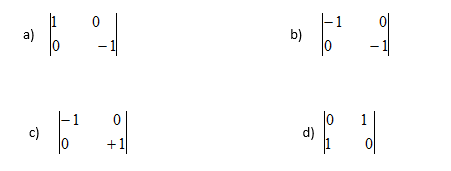
Q72. Which of the following transformation matrix represents the reflection about x-axis ?

a)                      
Computer Graphics & Digital Image Processing MCQS with Answer

         Q73. Which of the following transformation matrix represents the reflection about y-axis?

Computer Graphics & Digital Image Processing MCQS with Answer


Q74.Which of the following transformation matrix represents the reflection about origin?
Computer Graphics & Digital Image Processing MCQS with Answer


Q75. Which of the following transformation matrix represents the reflection about line y=x ?
Computer Graphics & Digital Image Processing MCQS with Answer
Computer Graphics & Digital Image Processing MCQS with AnswerS
                
61 d
62 a
63 a
64 b
65 c
66 c
67 b
68 b
69 a
70 c
71 c
72 a
73 c
74 b
75 d

Computer Graphics & Digital Image Processing MCQS with Answer SET 4

1 Comment »

Computer Graphics & Digital Image Processing MCQS with AnswerS

We have made some Computer Graphics & Digital Image Processing MCQS (Mulitiple Choice Questions) which helps to prepare for competitive exams and various university exams or btech computer science 6th sem exams.This might be usefulgate preparation too.

Q46. Which transformation produces a mirror image of an object ?

a)Rotation       b)shearing                  c)scaling                               d)reflection.

Q47. Which transformation is described as rotation by 180 degree ?

a)Rotation       b)shearing                  c)scaling                               d)reflection

Q48. What is the average access rate of 1024x1024 frame buffer , with an average access rate per pixel of 200ns on a simple color display?

a)1.6                                       b)1.5                             c)1.4                    d)None of these.

Q49. In a 512x512 raster on a monochrome display with an average access rate of 200ns per pixel.What is refresh rate?

a)16.07                                    b)19.07                           c)15.07                         d)None of these.

Q50. Consider Raster System with resolution of 640x480 . what is the size of frame-buffer (in Bytes) is needed to store 12-bits per pixel ?

a)460800                                      b)1920 KB                                          c)7.5MB     d)None of these.

Q51. Consider Raster System with resolution of 1280x1024 . what is the size of frame-buffer (in Bytes) is needed to store 12-bits per pixel ?

a)460800                                      b)1920 KB                                          c)7.5MB     d)None of these.

Q52. Consider Raster System with resolution of 2560x2048 . what is the size of frame-buffer (in Bytes) is needed to store 12-bits per pixel ?

a)460800                                      b)1920 KB                                          c)7.5MB     d)None of these.

Q53. Which classification of Polygon is based on where the line-segment joining any two points within the polygon is going to lie ?

a)Convex Polygon        b)Concave polygon     c)None of these        d)Both of these.

Q 54. Which classification of Polygon is not based on where the line-segment joining any two points within the polygon is going to lie ?

a)Convex Polygon        b)Concave polygon     c)None of these        d)Both of these.

Q55. As in Even-Odd Method , the point is considered inside the Polygon Boundary if
a)even no. of intersections                             
  b)odd no. of intersections                  c)either a or b                         d)neither  a  nor  b

Q56. Which of the following transformation  is called as twist or tilt transformation ?

a)      Shear trandformation
b)      Scale transformation
c)       Translation
d)      None of these

Q57.How many electron guns are used in CRT ?

a)3      b)2        c)4     c)none of these

Q58. How many electron guns are used in DVST ?

a)3      b)2        c)4     c)none of these

Q59. Which of the following statement is true ?

a)DVST has no referesh buffer thus to eliminate a picture section ,the entire screen must be erased and to modified.
b)DVST creates bright picture.
C)Both (a) and (b).
d) None of these.

Q60. Aspect ratio is defined as :

a)      No.of horizontal points
b)      No. of vertical points.
c)       (a) divided by (b).

d)      None of these

Computer Graphics & Digital Image Processing MCQS with AnswerS

46 d
47 d
48 a
49 b
50 a
51 b
52 c
53 a
54 b
55 b
56 a
57 a
58 b
59 c
60 c

Computer Graphics & Digital Image Processing MCQS with Answer SET 3

No Comments »

Computer Graphics & Digital Image Processing MCQS with AnswerS

We have made some Computer Graphics & Digital Image Processing MCQS (Mulitiple Choice Questions) which helps to prepare for competitive exams and various university exams or btech computer science 6th sem exams.This might be usefulgate preparation too.

Q31.  If a line is drawn from A(5,5) to B(13,9) using Bresenham’s Algorithm .Then  if First pixel is (5,5) then sixth pixel is :
a)(7,6)                       b)(6,6)                            c)(8,7)                                    d)None of these

Q32. Let a triangle is defined by A(2,2), B(4,2),C(4,4) and is rotated by 90 degree about an origin .Then after transformation point A(2,2) will be transformed into :

a )A’(-2,4)                                              b) A’(-2,2)                                                              c)   A’(-4,4) 
d) None of these

Q33. Let a triangle is defined by A(2,2), B(4,2),C(4,4) and is rotated by 90 degree about an origin .Then after transformation point B(4,2) will be transformed into :

a )B’(-2,4)                                              b) B’(-2,2)                                                              c)   B’(-4,4) 
d) None of these

Q34. Let a triangle is defined by A(2,2), B(4,2),C(4,4) and is rotated by 90 degree about an origin .Then after transformation point C(4,4) will be transformed into :

a )C’(-2,4)                                              b) C’(-2,2)                                                              c)   C’(-4,4) 
d) None of these

Q35. When a square ABCD , whose coordinates are A(0,0) , B(3,0),C(3,3),D(0,3) is translated by 2 units in both of x-direction and y-direction .Then after translation , point A(0,0) is transformed into :

a)A’(0,3)                                           b)A’(2,2)                                  c)A’(5,2)                             d)A’(5,5)


Q36. When a square ABCD , whose coordinates are A(0,0) , B(3,0),C(3,3),D(0,3) is translated by 2 units in both of x-direction and y-direction .Then after translation , point B(3,0) is transformed into :

a)B’(2,5)                                           b)B’(2,2)                                  c)B’(5,2)                             d)B’(5,5)

Q37. When a square ABCD , whose coordinates are A(0,0) , B(3,0),C(3,3),D(0,3) is translated by 2 units in both of x-direction and y-direction .Then after translation , point C(3,3) is transformed into :

a)C’(2,5)                                           b)C’(2,2)                                  c)C’(5,2)                             d)C’(5,5)


Q38. When a square ABCD , whose coordinates are A(0,0) , B(3,0),C(3,3),D(0,3) is translated by 2 units in both of x-direction and y-direction .Then after translation , point D(0,3) is transformed into :

a)D’(2,5)                                           b)D’(2,2)                                  c)D’(5,2)                             d)D’(5,5)

Q39.   Which transformation changes  the  size of object ?

a)shearing                                         c)rotation
b)scaling                                         d))None of these

Q40. Which transformation distorts the geometry of object ?

a)shearing                                         c)rotation
b)scaling                                         d))None of these

Q41. Is two-Dimensional rotation and scaling is commutative if Sx=sy or ɵ=nΩ  ?

a)      Yes                      b) No                               c)  None of these                   d) may be.

Q 42. If a triangle with vertices A(0,0), B(1,1),C(5,2) to twice its size, while keeping C(5,2) fixed , then A(0,0)  will be transformed into :

a)A’(-3,0)                                      b)A’(-5,-2)                            c) A’(5,2)                               d)None of these

Q 43. If a triangle with vertices A(0,0), B(1,1),C(5,2) to twice its size, while keeping C(5,2) fixed , then     B(-3,0)  will be transformed into :

a)B’(-3,0)                                      b)B’(-5,-2)                            c) B’(5,2)                               d)None of these

Q44. If a triangle with vertices A(0,0), B(1,1),C(5,2) to twice its size, while keeping C(5,2) fixed , then C(5,2)  will be transformed into :

a)C’(-3,0)                                      b)C’(-5,-2)                            c) C’(5,2)                               d)None of these

Q45. Reflection along the line y=x is equivalent to reflection along the x-axis followed by counterclockwise by ɵ degrees.Then the value of ɵ is :


a)90                                            b)45                                           c)180                                      d)None of these.

Computer Graphics & Digital Image Processing MCQS with AnswerS

31 d
32 b
33 a
34 c
35 b
36 c
37 d
38 a
39 b
40 a
41 a
42 b
43 a
44 c
45 a